

Language levels
Welcome!
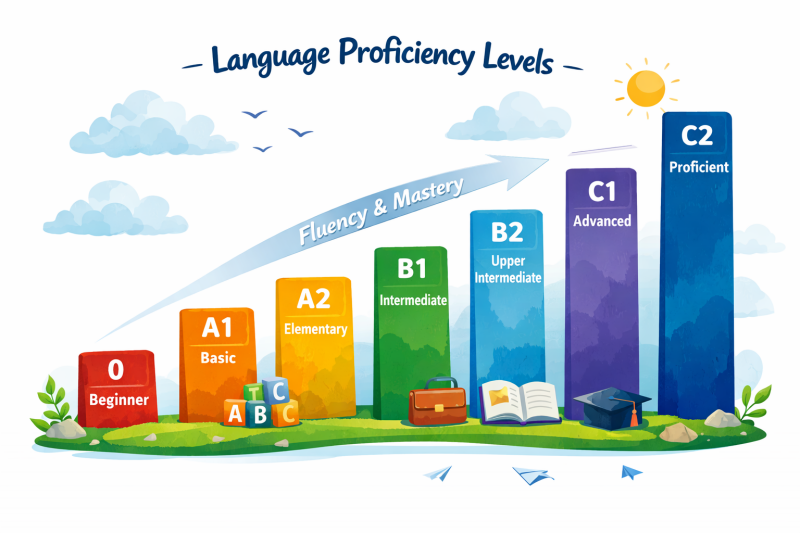
This page is here to help you better understand the different language levels used to describe a learner’s ability in English (and other languages). You may see levels such as 0, A1, A2, B1, B2, C1, and C2 when looking at our courses, and these are part of an internationally recognized system used to measure language progress.
Each level represents a step in a learner’s journey—from complete beginner (Level 0) to advanced and near-native proficiency (C2). Understanding these levels can help you choose the course that best matches your current ability and learning goals.
Below, you’ll find a simple explanation of each level to guide you.

Level 0 – Complete Beginner
At Level 0, the learner is just starting their language journey. They may have little to no exposure to English and are not yet able to understand or use the language in a meaningful way. This stage focuses on building comfort, recognizing basic sounds, and becoming familiar with simple words through listening, repetition, and visual support.
At this level, learners are beginning to develop confidence and are encouraged to participate in a fun and supportive environment where making mistakes is part of the learning process.
At this level, you may:
- Not understand spoken English yet
- Be unable to form words or sentences in English
- Recognize a few basic words (such as colors, numbers, or simple objects)
- Rely heavily on gestures, visuals, and repetition
- Feel shy or unsure when hearing or trying to use English

A1 – Beginner
At the A1 level, the learner is beginning to use English in simple and practical ways. They can understand and use basic words and phrases related to everyday situations, especially when people speak slowly and clearly. Communication is still limited, but learners can start to express simple needs and interact in very basic conversations.
This stage focuses on building a strong foundation, helping learners gain confidence while using English in familiar and predictable situations.
At this level, you may:
- Understand and use simple greetings and introductions
- Ask and answer basic questions (name, age, where you’re from, etc.)
- Recognize common everyday words and phrases
- Speak in short, simple sentences
- Need others to speak slowly and clearly
- Sometimes pause or struggle to find the right words

A2 – Elementary
At the A2 level, the learner can communicate in simple and routine situations with more confidence. They are able to understand frequently used expressions and can take part in basic conversations about familiar topics such as daily life, work, shopping, and hobbies.
At this stage, learners are becoming more comfortable using English, though they may still need time to think and may make mistakes when speaking or understanding more complex ideas.
At this level, you may:
- Understand common phrases and everyday expressions
- Have simple conversations about familiar topics (daily routine, family, hobbies, etc.)
- Ask and answer questions in predictable situations
- Describe basic information about your life and experiences
- Understand the main idea when people speak clearly and slowly
- Still struggle with longer conversations or unfamiliar topics

B1 – Intermediate
At the B1 level, the learner can communicate independently in many everyday situations. They are able to understand the main points of clear speech and can take part in conversations on familiar topics such as work, school, travel, and personal interests.
At this stage, learners can express their thoughts, opinions, and experiences more clearly, even if they still make mistakes or need time to organize what they want to say.
At this level, you may:
- Understand the main idea of conversations and simple discussions
- Take part in everyday conversations with more confidence
- Talk about experiences, plans, and opinions
- Handle common situations while traveling or living abroad
- Speak in longer sentences, though not always perfectly
- Sometimes struggle with complex language or fast speech

B2 – Upper Intermediate
At the B2 level, the learner can communicate clearly and confidently in a wide range of situations. They can understand the main ideas of more complex texts and conversations, including discussions on both familiar and unfamiliar topics.
At this stage, learners are able to express themselves more fluently and spontaneously, with fewer pauses. They can take part in longer conversations, explain their opinions, and interact with others more naturally.
At this level, you may:
- Understand extended conversations and more complex ideas
- Communicate fluently in most everyday and professional situations
- Express and explain opinions clearly
- Take part in discussions and debates
- Speak with fewer pauses and more natural flow
- Still make mistakes, especially with very advanced or nuanced language

C1 – Advanced
At the C1 level, the learner can use English effectively and flexibly in a wide range of situations. They can understand complex language in both spoken and written forms, even when it is not clearly structured. Communication is smooth and well-organized, with the ability to express ideas clearly and in detail.
At this stage, learners can adapt their language depending on the situation, whether social, academic, or professional, and can communicate with a high level of independence and confidence.
At this level, you may:
- Understand complex conversations, including fast or less structured speech
- Express ideas fluently and in detail with minimal hesitation
- Use language flexibly in social, academic, or professional contexts
- Follow and contribute to discussions on a wide range of topics
- Adjust your tone and style depending on the situation
- Occasionally make small mistakes, but without affecting communicatio

C2 – Proficient
At the C2 level, the learner has mastered the language and can use it with ease in any situation. They can understand virtually everything they hear or read, including complex, abstract, or nuanced language. Communication is effortless, precise, and natural, even in challenging or unfamiliar contexts.
At this stage, learners can express themselves fluently and accurately, capturing subtle meanings and adapting their language perfectly to different situations.
At this level, you may:
- Understand virtually all spoken and written English
- Communicate effortlessly and naturally in any situation
- Express complex ideas clearly, precisely, and in detail
- Understand nuance, tone, and subtle differences in meaning
- Adapt your language perfectly to different contexts and audiences
- Rarely make mistakes, and easily correct them when you do
